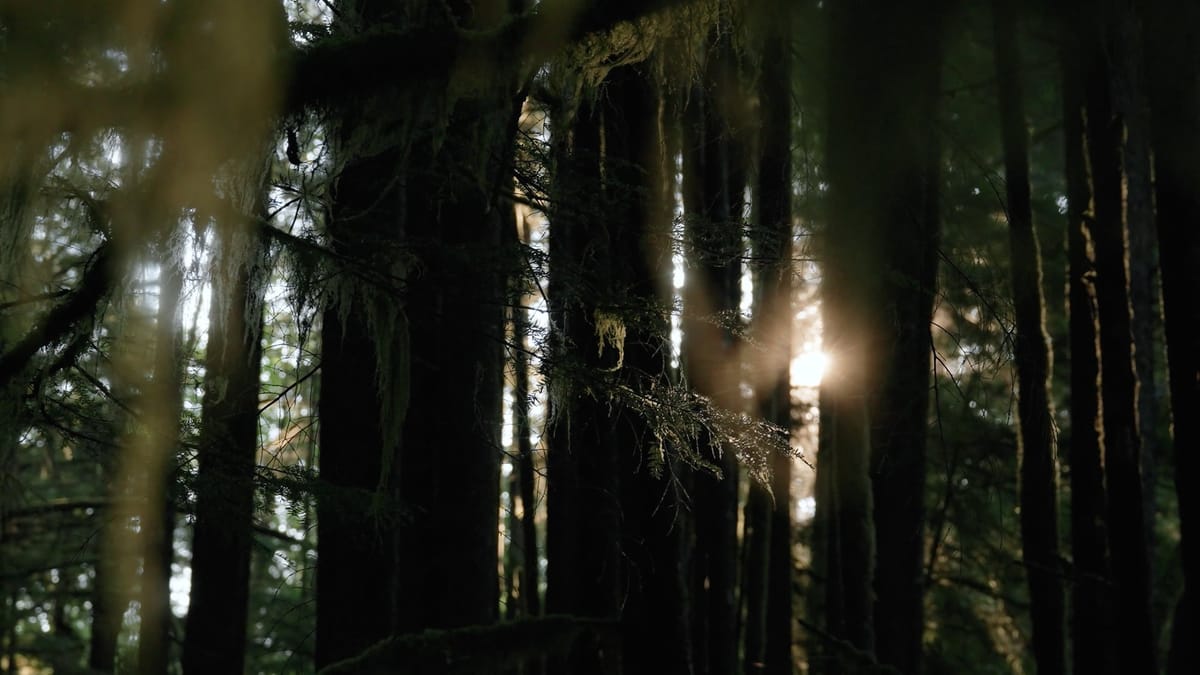
Light through the pines

A neighbour’s bonfire filled the forest with smoke, and the sun did the rest.
Light through trees is one of the oldest shots in film. We made it anyway, because on this particular morning the forest was full of smoke from a farmer's bonfire, and the light did something we had never seen.
Chapters
- 0:00 Under the canopy
- 0:06 The light breaks through
- 0:11 Stillness
Rays need something to hit
Sunbeams are only visible when there is something in the air for the light to hit: mist, dust, pollen or smoke. Most of the time, a forest is too clean. This morning, a farm on the edge of the wood was burning old branches, and a thin layer of smoke had drifted in among the trees. When the sun came over the ridge, every gap in the canopy turned into a beam.
We had about twelve minutes before the smoke thinned.
Moving slowly
The film has one slow movement: a gentle push towards the brightest gap in the trees. We used a small slider, one metre long, and took eleven seconds to travel forty centimetres. At that speed, the movement is almost invisible, but your eye feels it. It pulls you into the forest.
We tried the same shot handheld. It looked like a holiday video.
Move the camera only if the movement means something. Here it meant: come closer.
Noa Park
Exposure
Filming into the sun is hard. If you expose for the sky, the trees go black. If you expose for the trees, the sky burns to white. We exposed for the brightest part of the beams and let the trunks fall into shadow, which is how the eye remembers a forest like this anyway: dark shapes, bright air.
Sound
The birdsong is real, recorded twenty minutes later, when the birds had woken up properly. The crackle you can just hear under it is the bonfire, recorded on the way out, two hundred metres away.
The edit
This film is one shot, but it went through four versions. The first was thirty seconds long and started in darkness. The second added a slow fade from black. The third cut the fade and started with the light already present, which lost the moment of discovery. The fourth, the one you can watch here, starts just before the brightest beam appears and ends as it fades.
Fifteen seconds turned out to be the length of one breath in and one breath out, slowly. We did not plan that, but it is why the film feels calm.
The same place, one week later
We went back a week later, on a clear morning with no bonfire. The forest was beautiful and completely ordinary. The light fell on the ground in patches, but the air between the trees was invisible. It was a good reminder that the most important thing in this film was not the forest or the sun, but a farmer tidying his field.
Moving slowly, in practice
Sliders are simple tools that are hard to use well. The trick is not speed but consistency: a movement that starts and stops smoothly, with no jolt. Our slider has a small crank, and Noa turns it with two fingers, counting under her breath. Eleven seconds for forty centimetres works out at roughly one turn every two seconds. We practised it five times on the path before the light came, which felt silly at the time and turned out to be the reason the shot works. The first real take was the good one.