Light trails from the footbridge

Six hundred long exposures, a shaking bridge and no cars at all.
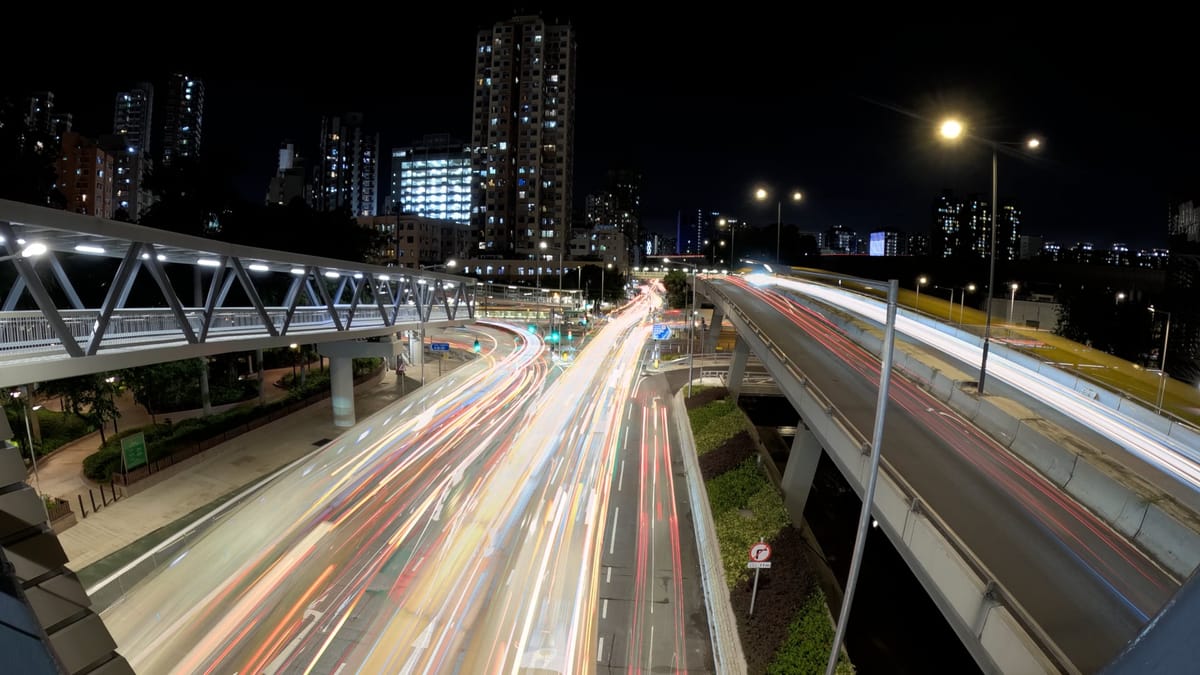
Ten seconds of light trails on a city road at night, filmed from a footbridge above the traffic. The cars are not visible at all: only the light they leave behind.
Chapters
- 0:00 The junction
- 0:05 Rush of light
How light trails work
Light trails are made with a long exposure. The camera keeps its shutter open for a second or more, and every moving light is drawn as a line across the picture. Cars disappear, because each one is in any one place for only a moment; their headlights and tail lights remain.
For a film, we took one long-exposure photograph every two seconds for twenty minutes, then played the six hundred photos in sequence. The result is ten seconds of moving light.
The footbridge
Footbridges over busy roads are the classic spot for light trails. The view looks along the road, so the trails curve away towards the city. The problem is vibration: every heavy lorry makes the bridge shake. We hung the camera bag from the tripod to make it heavier, and chose a spot near the end of the bridge, where it shakes least.
The cars are the paintbrush. You only see the paint.
Noa Park
Settings
We used a small aperture and the lowest sensitivity the camera allows, so the exposure could be long without the picture becoming too bright. Each photo was exposed for about one and a half seconds, which made the trails long and smooth.
Timing
We filmed at about eight in the evening, when the sky was fully dark but the roads were still busy. Later, the roads empty and the trails become thin and broken. Earlier, the sky is too bright and the lights do not stand out.
The edit
Six hundred photographs became ten seconds of film. In the edit, we joined them at twenty-five frames a second, then smoothed the gaps between frames with a little blending, so the trails flow instead of jumping. The colour is as the camera saw it: orange street lights, white headlights, red tail lights. We darkened the sky slightly to make the trails stand out. There is no sound recording; Lina built a soft, low rush of traffic from a recording made on the same bridge.
The city at night
This is a different kind of city film from our usual ones. There are no people in it, and no single subject. It is a picture of movement, of everyone going somewhere at once.